Jijang Fractal · Part 3
The Jijang Fractal
A Concise Guide to Karma, Compassion, and Responsibility
By Hugo J. Smal
Short answer:
Jijang Bosal is the Korean Buddhist presence behind the Jijang Fractal: a figure of compassion, vow, descent, protection, memory, and responsibility. Hugo J. Smal reads Jijang not as doctrine alone, but as a recurring structure within life, writing, grief, and return.
The Reality of Jijang
Some questions are better not avoided. This is one of them.
Is Jijang real? For some readers, the answer is simple. Yes. For them, Jijang Bosal is a real bodhisattva. A spiritual presence. A being connected with compassion, vow, difficult transitions, and the places where suffering has not yet been resolved.
For other readers, the answer is equally simple. No. For them, Jijang is a religious construct. A cultural product. A historically evolved symbol without objective metaphysical reality.
I understand both positions. And I am not going to try to resolve that tension cheaply here.
For the moment we reduce such questions too quickly, we often lose something important. The modern mind often feels compelled toward a hard choice. Either literal belief. Or sceptical demystification. Either it is true. Or it is projection.
But human experience is rarely that neat.
Take love. Is love “real”? Biologically, we can describe processes. Hormones. Neurochemistry. Behavioural mechanisms. But that does not automatically say everything. The lived experience of love does not disappear simply because an explanation is possible.
The same applies to art. To grief. To beauty. To music. To moral experience. A neurologist can measure brain activity when someone is moved by Bach. But that does not mean Bach has been explained.
Human experience lives on multiple levels at once.
That does not mean all claims are equally valid. Not everything people feel is true. Not every spiritual conviction deserves automatic immunity from criticism.
But it does mean that reductionism rarely tells the whole story.
So perhaps the question: “Does Jijang exist objectively?” is not the only relevant question. Perhaps there is another. An older one. A more human one.
What becomes visible in this presence?
That question is not intended as an escape. On the contrary. It is serious.
For even when someone does not share a metaphysical belief, another reality remains: the reality of symbolic resonance. That is not a small domain.
Human beings have always thought through images. Through stories. Through myths. Through religious language. Through moral icons. Through archetypes.
Not because people were foolish. But because some human experiences are difficult to fully capture in dry abstraction.
So the question is not only: “Does Jijang exist?” But also: why does this presence exist in the human imagination?
What makes it necessary? What makes it recognisable? Why does precisely this motif return?
Not power. Not victory. Not judgment. But presence within the unresolved.
That alone is striking. Here, Jung briefly touches the conversation again. Not because he confirms religious claims. But because he helps us understand that symbols sometimes make something human visible that cannot easily be formulated in purely rational terms.
A symbol does not need to be literally empirically “true” in order to function psychologically or morally in a real way.
The question then becomes: what does Jijang represent? Compassion? Perseverance? Descent? Containment? The willingness not to immediately reject human darkness?
Or, more personally: the possibility of remaining present where you would normally want to flee?
These are not trivial questions. For me, something slowly began to become clear here. Even if someone does not regard Jijang as an objectively existing bodhisattva, the human possibility to which this presence points remains relevant.
Perhaps even urgent. For our time does not necessarily suffer from a shortage of information. But from a shortage of holding capacity. Not from a shortage of opinions. But from a shortage of presence. Not from a shortage of analysis. But often from a shortage of compassionate perseverance.
And yet I want to remain careful here. For this is not the same as saying: “Jijang is simply a psychological archetype.” That would be too reductionist.
It would reduce a living spiritual tradition to Western psychological language. That would not be fair.
What I am trying here is something subtler. Not to deny. Not to annex. But to leave space.
Space for the believing reader. Space for the sceptic. Space for the one who lives somewhere in between.
For perhaps not everyone needs to draw the same metaphysical conclusion in order to take the same moral question seriously.
That is, for me, ultimately the core. Not the demand that everyone believe the same thing. But the invitation to consider the same human challenge.
What does it mean to remain present where suffering has not yet been resolved? What does it mean not to look away immediately? What does it mean, in human groundlessness, to seek not only analysis, but also moral presence?
If that is what Jijang makes visible, then the question of “reality” may be larger than a simple yes or no.
Perhaps there is a third possibility.
Not: literal metaphysical certainty. Not: cultural fiction. But: a human condition that has become visible through spiritual language.
And precisely there, the next step opens. No longer the question of whether Jijang is real. But: what happens when a human being learns to live from the presence of Jijang?
The Presence of Jijang
If we leave the question of literal metaphysical certainty open for a moment, something else remains. Something perhaps more immediately human.
Not: does Jijang exist objectively? But: what does it mean to live from the presence of Jijang?
That is not a small shift. It changes almost everything. For then we are no longer speaking only about religious belief. Not only about philosophical analysis. Not only about symbolic interpretation. But about a lived human possibility.
A way of being present. A moral orientation. Misschien zelfs een vorm van innerlijke discipline. But not the hard discipline of self-control or moral superiority. Rather something quieter. Something more difficult.
The willingness not to immediately run away when things grow dark.
That sounds simple. In reality, it is exceptionally difficult.
Human beings flee constantly. Not only literally. Also inwardly. We flee into work. Into explanations. Into anger. Into rationalisation. Into belief. Into irony. Into ideology. Into numbness. Into control. Into analysis. And now, increasingly, into spirituality.
Not because people are weak. But because pain wants to be made bearable. That is human.
And yet the presence associated with Jijang seems to suggest something else. Not the denial of pain. Not the romanticising of suffering. Not the glorification of victimhood. But presence. Remaining.
Not as passivity. Not as powerlessness. But as a conscious refusal to immediately reject human fracture.
That is fundamentally different. For much of our culture revolves around speed. To solve. To optimise. To move on. To heal. To perform. To win.
Even moral conflicts are often approached as though they must be resolved quickly. Who is right? Who is guilty? Who must be corrected? Who must disappear?
But some human realities do not work that way. Not grief. Not trauma. Not moral guilt. Not loss. Not relational rupture. Not ageing. Not existential anxiety.
Some things cannot be optimised. Only carried.
And perhaps that is precisely why this presence is so powerful. Not because it provides answers. But because it does not immediately disappear.
Here, something unexpected comes together. Sartre taught us that freedom is heavy. That people often try to evade responsibility. Buddhism shows that identity is less fixed than we think. Jung reminds us that not everything within us is transparent or rational. Wonhyo shows how perception helps shape reality.
And Jijang? Jijang seems to add something else. Not a theory. Not a doctrine. But a moral presence. The possibility of remaining where others depart.
That must be said carefully. For this is not a call to endless self-sacrifice. Not every suffering must be embraced. Not every destructive situation must be endured. Not every relationship must be held onto.
That would be unhealthy. The presence of Jijang does not mean limitless martyrdom.
What it does suggest is something subtler. That some forms of maturity do not lie in escape, but in endurance.
Not in disappearing, but in remaining present.
Not in immediate clarity, but in the capacity to bear uncertainty without moral paralysis.
Perhaps this also touches something many people intuitively recognize. The experience that the most meaningful human presence is not always the one that immediately brings a solution. But the one that remains.
The friend who does not disappear. The parent who does not avoid the difficult conversation. The doctor who remains honestly present when healing is no longer possible. The beloved who does not immediately produce rational explanations. The human being who does not instantly look away.
These are small human forms of something larger. Not perfect. Not holy. But recognisable.
Perhaps that is why this presence resonates so strongly. Because it does not begin in metaphysics. But in something human.
And yet. Even here, a tension remains. For presence alone is not enough. Remaining without direction can also become stagnation. Suffering can also repeat itself without transformation. Trauma can circulate for generations without insight. Guilt can continue to fester. Pain can become patterns.
And precisely there, a next question begins to press itself forward. If human choices, wounds, denials, and forms of compassion do not simply disappear, how do they move onward? Not as isolated incidents. But as patterns.
And there we come close to karma.
Karma Without Superstition
Few concepts in the West are at once so familiar and so misunderstood as karma. In popular culture, karma is often presented as a kind of moral bookkeeping. You do something good. Something good comes back. You do something bad. The universe punishes you.
Almost as if somewhere there is a cosmic administrator keeping score. That image is understandable. It is simple. It offers moral order. And perhaps also comfort. But it does not do justice to the richness of the original idea.
In the Buddhist tradition, karma fundamentally refers to action. To intentional action. And to the consequences that arise from it. Not as mechanical punishment. Not as magical retribution. But as continuation. That difference is fundamental.
For the moment karma is seen as a supernatural system of reward or punishment, human complexity disappears. Then suffering is quickly read as deserved. And that is morally dangerous.
Not every suffering is guilt. Not every illness is the result of moral failure. Not every loss is cosmic correction. That must be clear.
What interests me here is another reading. One that lies closer to human experience. For even without metaphysical assumptions, we all recognise that actions have consequences.
Words linger. Betrayal changes relationships. Love shapes children. Violence leaves traces. Silence has consequences. Compassion too. A single event can reverberate for decades.
Not because some mystical system decrees it. But because human reality functions that way. That is not esoteric. That is recognisable.
A child who is structurally humiliated may carry those traces for a lifetime. Someone who unexpectedly receives genuine kindness may as well. A war ends on paper. But continues to live in families. In bodies. In cities. In language. In silence. In national reflexes.
That may not be traditional karmic doctrine in the strict doctrinal sense. But it makes the intuitive point immediately understandable: human actions do not simply disappear. They move onward.
Here, karma begins to look less like magical thinking and more like moral causality. Not perfectly linear. Not fully predictable. But real nonetheless.
And precisely there, an interesting bridge emerges for me. For modern science has its own languages for certain parts of this terrain. Psychology speaks of conditioning. Trauma research of intergenerational transmission. Sociology of norm formation. Network theory of the spread of behaviour and influence. Behavioural science speaks of repetition and feedback loops.
None of these disciplines “prove karma” in a religious sense. Nor do I claim that. But they do show that human influence often spreads in ways that are more complex and more enduring than simple linear intuitions suggest.
That suddenly makes karma seem less exotic. Not as an article of faith. But as a serious moral framework for thought.
At the same time, we must be careful. For not everything can be neatly explained. Not every tragedy has a recognisable cause. Not every human fate is understandable. A mature vision of karma must leave room for mystery without immediately collapsing into fatalism.
For fatalism is precisely one of the most dangerous distortions. “It is my karma.” “It was apparently meant to be.” “There is nothing I can do about it.” Such statements sometimes sound spiritual. But often function as escape.
And then we are once again close to Sartre’s bad faith. For responsibility is then replaced by spiritual passivity.
That is not what I mean here. On the contrary. If karma is taken seriously as moral continuation, responsibility becomes greater. Not smaller.
For then it is not only what I feel today that matters. But also what I pass on. What I repeat. What I normalize. What I do not interrupt. What I leave behind in others.
That makes karma uncomfortable. But also morally mature.
And here, the bridge to Jijang becomes important. For if human patterns truly continue through pain, love, denial, violence, silence, and care, a difficult question emerges. Who remains present within that network of continuation? Who does not look away? Who does not simply say: “Everyone has their own fate.”
Perhaps that is precisely why the presence of Jijang feels so powerful. Not as judge. Not as administrator. Not as cosmic controller. But as presence in the midst of human continuation. Not to punish. But to remain present where patterns have not yet been broken.
And yet something is still missing. For if actions continue, they rarely do so neatly. Not linearly. Not as a simple chain of cause and effect.
Human reality behaves more messily. More relationally. More repetitively. Sometimes as though small events develop unexpectedly large resonance. Sometimes as though patterns repeat themselves across different scales.
And precisely there, I began searching for another language. Not purely spiritual. Not purely psychological. Not purely philosophical. But something semi-formal. A model of thought. A way of making moral resonance visible.
There, the formula appears.
The Formula
There came a moment when words alone were no longer enough for me. Not because language fails. On the contrary. Much of what I have described so far — freedom, emptiness, shadow, presence, moral continuation — lives precisely in language.
But sometimes a thought asks for another form. Not to imitate precise science. Not to borrow authority from mathematics. But to make a pattern more sharply visible. That was the moment when the formula appeared.
Not as revelation. Not as an academic discovery. Rather as a working note that kept stubbornly returning. An attempt to think something relational and moral in a more compact form.
The notation reads:
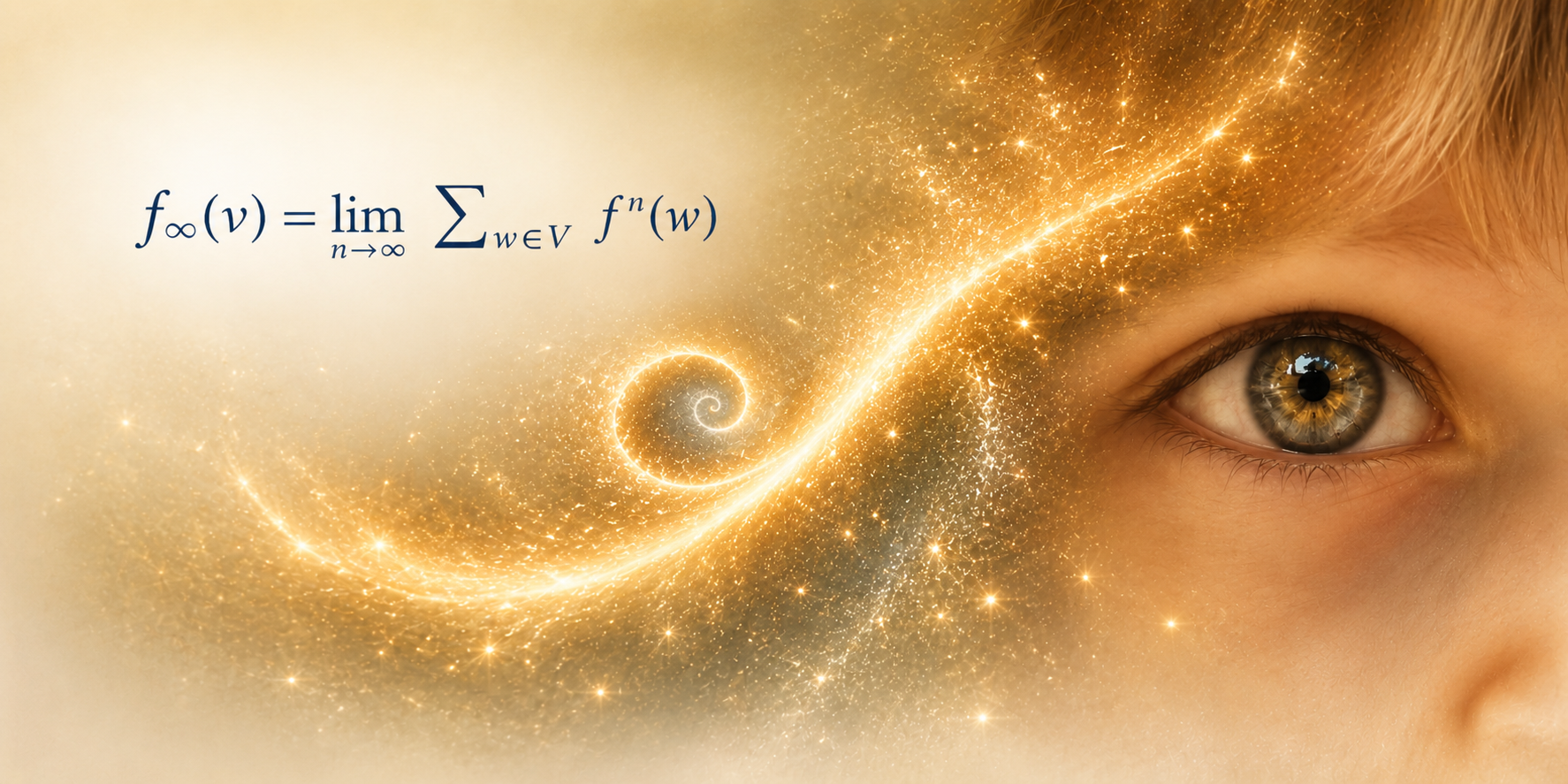
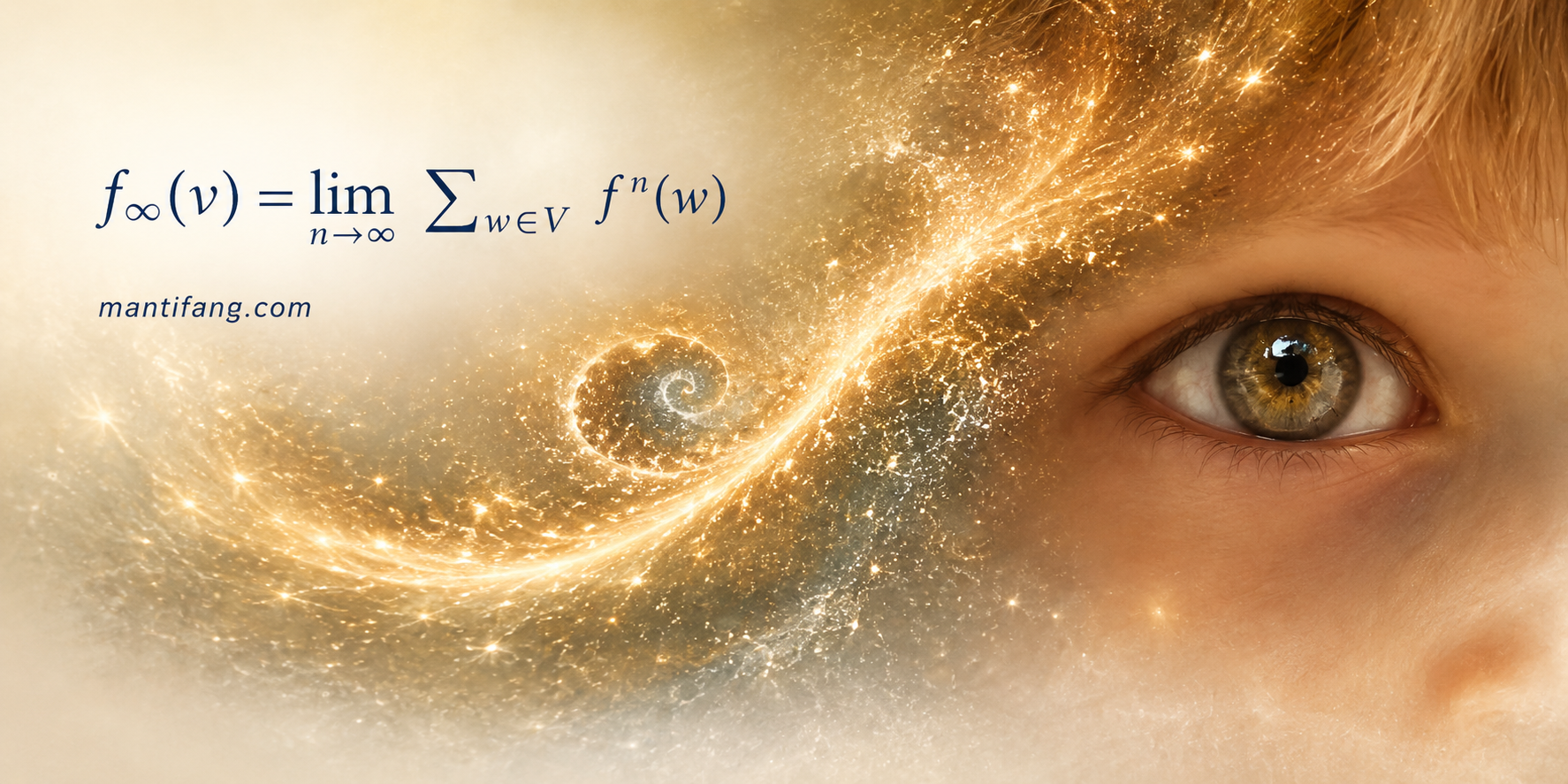
\(f^\infty(v) = \lim_{n\to\infty} \sum_{w\in V} f^n(w)\)
For readers who immediately recoil at symbols: stay with me a moment longer. This is not an exam. Nor is it an attempt to reduce human experience to algebra.
What is happening here is more modest. And perhaps, at the same time, more ambitious. I am trying to make an intuition visible.
Namely this: that human actions do not remain isolated, but can repeat, continue, and resonate in others as patterns.
Let us look at it calmly. \(v\) stands here for a receiving consciousness. A human being. A node. Someone who lives in relation. Not necessarily passive. But in this notation, the one who receives influences.
\(w\) stands for other sources within the network. Other people. Other choices. Other actions. Other lives. Not abstract objects. But other points of influence.
\(V\) stands for the wider field in which those relationships exist. A community. A family. A culture. A history. A relational network.
\(f\) stands for influence, action, or continuation. Not something exactly definable in a physical sense. More like moral or human transmission. A choice. A word. A silence. A wound. An act of care. A betrayal. A gesture of love.
\(f^n(w)\) means that this influence does not occur only once. But iteratively. Repeatedly. Through time. Through behaviour. Through memory. Through habit. Through relational transmission.
And then: \(\sum\), the sum. The accumulation. The total of all those continuations. And finally: \(\lim(n\to\infty)\), the movement toward infinity. Not as a literal cosmological claim. But as an indication that human continuation often reaches further than our direct sight.
That consequences do not always allow themselves to be neatly closed within a single moment. That patterns can outlive us.
That is all. And at the same time, not little.
For if you translate this notation very simply, it says approximately: a human being is shaped in part by the accumulated, repeated influences of others within a relational field.
That is not especially mystical. That is why I ultimately arrived at the word fractal. Not because this is a mathematical fractal in the strict sense. It is not. I make no claim here of a Mandelbrot structure. No geometric self-similarity. No physical law.
But the intuition of recurring patterns across different scales proved useful.
An individual wound. A family dynamic. A cultural pattern. A historical trauma. A moral reflex. Sometimes such processes behave as though the same form returns at other scales. Not identically. But recognisably related.
That is why semi-formal. Not hard scientific. Not purely poetic. Something in between.
A working model. A framework for thought. A moral notation.
Perhaps this provokes resistance. Rightly so. For the moment philosophers begin writing symbols as though they were formulas, scepticism should remain active.
I respect that. This notation is not proof. Not an empirically validated theory. Not a finished scientific model. It is a conceptual attempt. A way of making visible something that often remains diffuse in ordinary language.
The question is therefore not: “Is this formula literally true?” But rather: Does it help us see something? Does it make something visible about human continuation, responsibility, and moral resonance that would otherwise be harder to name?
For me, the answer was yes. Not because the formula solved something. But because it concentrated something.
And perhaps that is ultimately what good symbols, strong philosophy, and useful models have in common. Not claiming absolute truth. But giving form to something that proves recognisable.
And yet one question still remains open. Why do I actually call this a fractal? That requires precision.
Why a Fractal?
An honest question presses itself forward. Why this word? Why fractal? Why not simply: pattern? Network? Moral resonance? Relational continuation?
Why use a term that for many people immediately evokes associations with mathematics, geometry, and complex systems? That is a fair question. And the short answer is: because none of the simpler words captures exactly what I am trying to describe.
A pattern can be linear. A habit as well. A network describes connection. But not necessarily repetition across different scales.
What drew me to the word fractal was precisely that intuition of return. Not simple repetition. But forms that return recognisably while context, scale, and manifestation change.
That matters. For human reality rarely repeats itself literally.
A child who learns to respond with fear does not simply reproduce exactly the behaviour of a parent. A culture does not literally repeat its history. A society does not perfectly copy earlier traumas. And yet we often recognise something. A form. A structure. A moral reflex. A dynamic. Something that is not identical — but related.
That is the intuitive space in which the word fractal became meaningful. Not as exact science. But as a model of thought.
Take a simple example. A parent avoids conflict. A child learns that tension is dangerous. That child grows up and develops relational patterns in which difficult conversations are postponed. Later, within a family, the same dynamic of avoidance emerges again. Not exactly. Not mechanically. But recognisably.
The scale changes. The form resonates.
Or take collective history. A war ends. Distrust. Nationalistic sensitivity. Silence. Enemy images. Protective mechanisms. Generations later, the circumstances are different. But some structures continue to live on. Not as perfect copies. But as recognisable resonances.
That is what I am trying to approach with fractal. Not geometric precision. But structural return.
For some readers, that may still sound too ambitious. I understand that. For the word fractal carries weight. Since Benoît Mandelbrot, many people think of fractals as mathematical objects with strict properties. Self-similarity. Scale invariance. Recursive complexity. That is fascinating. But that is not precisely what is happening here.
I do not claim that human morality behaves in a mathematically exact way like that. I do not claim that psychological patterns formally possess the same properties as natural fractals. That would be intellectually dishonest.
What I do claim is more modest. And perhaps precisely because of that, more useful. Namely: that human experience sometimes behaves as though certain relational and moral structures return across different levels. Not identically. Not exactly predictably. But recognisably.
Perhaps another image may help. A coastline. From a distance, it seems relatively simple. Up close, it proves jagged. Zoom in further, and complexity appears again. Not exactly the same forms. But related irregularity.
Mandelbrot used precisely such images to challenge classical geometry. I use the word fractal on a much looser, more moral level. Not to reduce human experience to mathematics. But to make visible that some human patterns do not behave in neatly linear ways.
That is essential. For classical moral intuition often thinks linearly. I do something. A result follows. The end. But human reality is rarely that simple. A single act can resonate unexpectedly far. A small gesture of kindness can continue to resonate for decades. A trauma can remain silently present across generations. An ideology can continue underground and later return in new forms.
That is not a straight line. That is relational complexity. And precisely there, “fractal” felt more honest to me than simply “a chain of cause and effect.”
Still, I want to emphasise something further here. The word fractal was not chosen to sound intellectually impressive. Not to borrow scientific seriousness. Not to suggest an aura of precision.
If that is the impression, then I must write more clearly. The choice emerged because I was searching for a language for: repetition, shifts of scale, moral resonance, relational accumulation, non-linear continuation. And no simpler word proved precise enough.
Perhaps not every reader will remain convinced. That is fine. The term is an invitation. Not a dogma. Almost a verb-like way of thinking.
Not: here is the truth. But: see whether this lens makes something visible.
And yet one important question still remains. For if I consciously use a semi-formal language, where does the boundary lie? What may a philosophical model claim? And what must it not claim? We need to be clear about that.
Science, Symbol, and Honest Boundaries
When someone introduces a formula, uses words like fractal, and tries to build bridges between philosophy, psychology, and Buddhist thought, a fair question arises: how far does this actually reach?
That is an important question. Perhaps even a necessary one. For ideas lose credibility when they claim more than they can bear.
So let me be clear. The Jijang Fractal is not a scientific theory. Not in the strict sense in which physics, formal mathematics, or experimental psychology develop theories. There is no empirical research programme validating this notation. No peer-reviewed model confirming it.
Anyone seeking that here will be disappointed. And rightly so. That is not what I am trying to do.
But that does not mean that everything which is not hard science is therefore meaningless. Human knowledge takes multiple forms. Science is an extraordinarily powerful instrument. Perhaps one of the most impressive human achievements ever. It helps us discover patterns. Test hypotheses. Correct errors. Investigate reality in a methodical way. That deserves respect.
But science is not the only way human beings organise meaning. That is not an attack on science. It is a simple observation.
Religions do that. Philosophy does that. Art does that. Stories do that. Symbols do that. Cultures do that. Even personal memories structure meaning without ever undergoing a laboratory test.
That does not mean all claims are equally valid. That would be intellectually lazy. A physical hypothesis and a religious metaphor do not function in the same way. A therapeutic insight and a mathematical proof are not interchangeable. A symbol is not a dataset. An experience is not an experiment. Precisely for that reason, precision matters.
What I am proposing here consciously occupies an in-between territory. Not hard science. Not merely poetry. Not religious orthodoxy. Not a psychological manual. Rather, a philosophical model of thought. An interpretative lens. A moral framework. An attempt to think certain human experiences together.
That brings us to a second question. Why then refer to science at all? Because some aspects of human experience do indeed touch empirical knowledge. For example: that behaviour spreads. That trauma can affect generations. That social norms continue to shape outcomes. That perception helps shape experience. That human beings deceive themselves. That relational systems develop feedback loops. These are legitimate fields of observation.
But here too, we must remain precise. The fact that some scientific insights resonate with parts of my intuition does not mean that “science confirms the Jijang Fractal.” That would be an unjustified leap.
What it does mean is that some aspects of human reality apparently function in ways that do not make this model of thought absurd. Nothing more. Nothing less.
The same applies to Jung. I have used Jung here deliberately. Not as a hard scientific authority. But as an influential interpretative thinker. His archetypes are not empirically proven objects in the way chemical elements are. But that does not automatically make their cultural or psychological usefulness worthless.
A symbol does not need to be measurable in order to be operative. Religious language functions in a similar way. When someone prays, meditates, performs a ritual, or morally orients themselves toward a spiritual presence, the scientific question is not the only one that matters.
That does not mean that all spiritual claims are true. But it does mean that human meaning-making is richer than a simplistic true/not-true reflex.
And precisely there lies the vulnerability of this project. For hybrid models carry risks. Too spiritual for sceptics. Too philosophical for religious literalists. Too symbolic for scientists. Too analytical for mystics.
I accept that risk. Not because I am uncritical. But because some human questions live precisely at the boundaries.
What is responsibility? What is moral continuation? What does presence mean? What happens to suffering? How far do human choices reach? These are not exclusively laboratory questions. But neither are they exclusively religious questions.
That is why another language had to emerge here. And yet the boundaries must remain clear. The Jijang Fractal does not claim: to be a law of nature, to be an empirically proven model of consciousness, to fully represent traditional Buddhist doctrine, to definitively confirm Jung, to enforce metaphysical truth.
What is being offered here is more modest. And perhaps therefore more usable. A lens. A space for thought. A moral invitation. A way of viewing responsibility, repetition, suffering, and compassion relationally.
Perhaps one day a scientist will see a testable hypothesis here. Perhaps a philosopher will see a category error. Perhaps a Buddhist will recognise a resonance. Perhaps a sceptic, a useful metaphor. Perhaps an ordinary reader, simply a recognition. All of that is permitted.
For the goal is not to enforce consensus. The goal is to make something visible. And the moment we hold onto that honesty, a new freedom emerges.
Then we no longer need to prove that everything is exactly correct. Then we may ask: does this help us see the human condition more clearly? And precisely there, another layer becomes important.
For until now, we have moved mostly in ideas. But ideas never arise in a vacuum. They grow in landscapes. Cultures. Memories. Places. For me, Korea is not a backdrop in this. But a moral landscape.
Korea as a Moral Landscape
Some ideas arise in books. Others in conversations. Some in crises. Others in silence. And some do not arise in a single place, but slowly, through repeated presence in a landscape that does not immediately explain itself.
For me, Korea is such a landscape. Not as an exotic backdrop. Not merely as an intellectual object of study. And certainly not as a spiritual projection screen for Western longings. That would be too easy. And dishonest.
Korea is a real country. Modern. Complex. Historically painful. Technologically advanced. Socially demanding. Spiritually layered. Full of contradictions. Precisely for that reason, it matters.
For moral landscapes are rarely simple. What struck me again and again in Korea was not one doctrine. Not one religious truth. Not one clear cultural message. But tension. Old beside new. Silence beside commerce. Temple space beside traffic pressure. Collective discipline beside deep personal loneliness. Historical trauma beside futuristic modernity. Ritual beside pragmatism. Not neatly resolved. But present.
Perhaps that is precisely why Korea became so important to me. Not as an answer. But as a space in which questions could remain without immediately being smoothed over.
There are countries where spirituality is primarily commercialised. And countries where religion manifests primarily as ideology. Korea knows those tensions as well. But there is something else alongside them. A public nearness to history. A tangibility of loss. A visible coexistence of modern life and older symbolic layers. A temple there is not necessarily a museum. A ritual not automatically folklore. A spiritual presence not immediately private psychology.
That makes something possible that can sometimes be harder to feel in strongly secularised contexts. Not belief. But resonance. The experience that human meaning does not unfold exclusively within rational abstraction.
I say that carefully. Not to romanticise Korea. No society is pure. No culture possesses moral superiority. Korea too knows painful shadows. Social pressure. Historical ruptures. Political conflicts. Economic hardness. Loneliness. Repression. Precisely that makes Korea human.
And perhaps precisely for that reason, relevant. For what moved me there was not perfection. But layeredness.
I think of temples. Of the physical experience of slowing down. Of the way silence there sometimes does not feel empty, but carrying. Of icons that do not seem merely decorative. Of public spaces in which history has not entirely disappeared. Of encounters in which courtesy and melancholy sometimes stand very close beside one another. Of the ongoing presence of a past that never fully goes away.
Perhaps others recognise that elsewhere. In Japan. In Italy. In India. In old European cities. That is possible. I claim no exclusivity. But my own path of thought ran through Korea. And that is not accidental.
For the Jijang Fractal could not have emerged in exactly the same form without this context. Not only because of Jijang Bosal himself. But because of a broader cultural sensibility. A relationship to time. To ancestors. To rupture. To collective memory. To ritual presence.
Even Korean history itself carries that tension. Colonisation. War. Division. Modernisation. Unimaginable economic acceleration. Cultural continuity and radical rupture at once. That leaves traces. Not only politically. But morally. Psychologically. Publicly. Sometimes palpable. Sometimes silent.
And precisely for that reason, Korea became for me not only a geographical place. But a moral landscape. An environment in which questions of responsibility, suffering, presence, and human continuation became tangible. Not theoretical. Lived.
Perhaps that is why the Jijang Fractal could never become a purely abstract philosophical model. It did not grow from conceptual schemes alone. But from encounters. Temples. Street scenes. Conversations. Friendships. Loss. Silence. Time. Even from the tension between hypermodernity and older spiritual presence.
That makes Korea in this journey not a backdrop. But context. Not an exotic background. But a co-shaping reality.
And yet. A landscape alone is not enough. Culture alone is no more sufficient. A person can live in the most meaningful environment and still change nothing. So in the end, everything returns to a simpler, more uncomfortable question. Not what a culture offers. But what a human being does with it.
Not what Korea means. But what you, the reader, recognise. For in the end, every moral question lives not in temples. Not in history. Not in philosophy. But in ordinary lives.
What I Want to Leave You With in Closing
If you have stayed with me this far, you have already given me more attention than most modern texts still receive. For that, I am grateful. Not because attention is a favour. But because in our time, attention has become a moral act.
We live in a world that constantly demands acceleration. Respond faster. Judge faster. Choose faster. Forget faster. Even suffering must be processed efficiently. Even grief is given deadlines. Even doubt must quickly make way for a clear position.
In such a time, thinking slowly together is already something meaningful in itself.
Perhaps during this journey you felt agreement. Perhaps resistance. Perhaps scepticism. Perhaps recognition. Perhaps moments when you thought: yes, exactly. Or precisely the opposite: no, this is where you lose me. All of that is fine.
I have never tried to convert you. Not to Buddhism. Not to existentialism. Not to Jung. Not to my language. Not even necessarily to the Jijang Fractal.
What I have tried to do is simpler. To open a space in which certain questions do not need to be immediately closed. Questions about responsibility. About continuation. About freedom. About suffering. About the human tendency to flee. About presence. About what we inherit. And about what we pass on.
Perhaps that is ultimately the core. Not what we believe. But what continues through us.
For every human being leaves traces. Sometimes visible. Sometimes not. A word that lingers. A glance. A silence. A gesture of care. A humiliation. A decision. A form of courage. A form of cowardice. A moment when someone felt seen. A moment when someone withdrew for good.
Much of what truly matters does not appear in the great books of history. It lives in small human transmissions.
That is why I believe less and less in the fantasy of the fully isolated individual. No one lives entirely unto themselves. No one emerges entirely from themselves. No one leaves the world untouched.
That is not a reason for guilt. But it is a reason for seriousness. And perhaps also for gentleness. For the moment you truly understand how much people carry — often invisibly — quick judgment becomes more difficult.
That does not mean everything must be forgiven. Not that responsibility dissolves. Not that boundaries disappear. But perhaps that moral maturity has less to do with absolute purity than with conscious presence.
I do not know whether Jijang is, for you, a religious reality. Nor does that need to be the case. Perhaps Jijang is, for you, a spiritual presence. Perhaps a moral icon. Perhaps a psychological resonance. Perhaps a cultural reality. Perhaps something for which you do not yet have language. Even that is permitted.
For the deeper question remains. What does it mean to remain present where suffering has not yet been resolved? What does it mean not to immediately reduce what is complex? What does it mean to think about responsibility not only retrospectively, but also forward? What does it mean not only to demand freedom, but also to carry its burden? What does it mean not to want to immediately numb, rationalise, or project every inner tension? What does it mean to truly remain?
I do not ask these questions from a position of superiority. Quite the opposite. I, too, avoid at times. I, too, know fear. I, too, sometimes use analysis as a hiding place. I, too, sometimes judge more harshly than wisdom would justify. I, too, live within the same patterns I am trying to understand here.
Perhaps it matters to say that aloud. No one speaks here from above. Only someone trying to look more carefully. Nothing more. But perhaps that is enough.
And if there is something I truly want to leave with you, then perhaps it is this: Not everything that matters can be solved. Not everything that hurts can be repaired. Not everything that is unclear needs to become immediately clear. Not every tension is a defect.
Sometimes maturity begins precisely where we stop treating every form of uncertainty as a malfunction. And sometimes compassion begins where analysis alone is no longer enough.
Perhaps that is what the presence of Jijang ultimately came to mean for me. Not an escape route. But a reminder. That staying is sometimes more courageous than leaving. That presence is sometimes more dignified than quick solutions. That moral seriousness and gentleness do not have to exclude one another. And that even in human groundlessness, a form of sustaining depth can remain possible. Not as possession. Not as certainty. But as a lived possibility.
In some Buddhist imaginations, such a reality appears as Indra’s Net. An infinite network of jewels in which each jewel reflects all the others. No single point completely separate. But no point without its own radiance either. Each diamond in itself. And precisely therefore, in relation.
Perhaps that comes closer to human reality than we often dare to admit. Not fully isolated. Not meaninglessly dissolved into an anonymous whole. But individual and intertwined. Free and relational. Vulnerable and effective. And perhaps even such a network first requires space. An open field. A sustaining possibility. Something that becomes visible in Korean Buddhist imagination in Heogongjang Bosal.
The open space. The sustaining emptiness. Not as absence. But as possibility. And within that space, Jijang moves. Not as judge. Not as a figure of escape. But as presence. As the one who remains where suffering has not yet been resolved.
Perhaps somewhere between these images lives the deepest intuition of what I came to call the Jijang Fractal. Not as a proven theory. Not as doctrine. But as a moral reality. A reality in which our choices resonate. Our wounds continue. And our compassion as well. And in which even a single human gesture may reach further than we will ever fully know.
What you do with that thought is yours. And it should be. For in the end, every philosophy, every religion, and every moral theory arrives at the same place: in a human life. In your choices. In your relationships. In your silence. In what you pass on. That is where everything truly lives.
Further Reading
Korean Buddhism and Jijang
- Stanford Encyclopedia of Philosophy — Korean Buddhism
- Kwan Um School of Zen — Bodhisattvas
- Mantifang — Jijang (Ksitigarbha) Archives
Karma and moral action
- Stanford Encyclopedia of Philosophy — Buddha
- Stanford Encyclopedia of Philosophy — Moral Responsibility
- Freedom and Responsibility in the Mirror of Buddhist Ethics
Compassion, presence, and ethics
The booklet is available in English, Korean, and Dutch for €9.95.
The booklet is available in English, Korean, and Dutch for €9.95.