
Across Traditions
Across Traditions — The Jijang Fractal in Faith, Philosophy, and Ethics
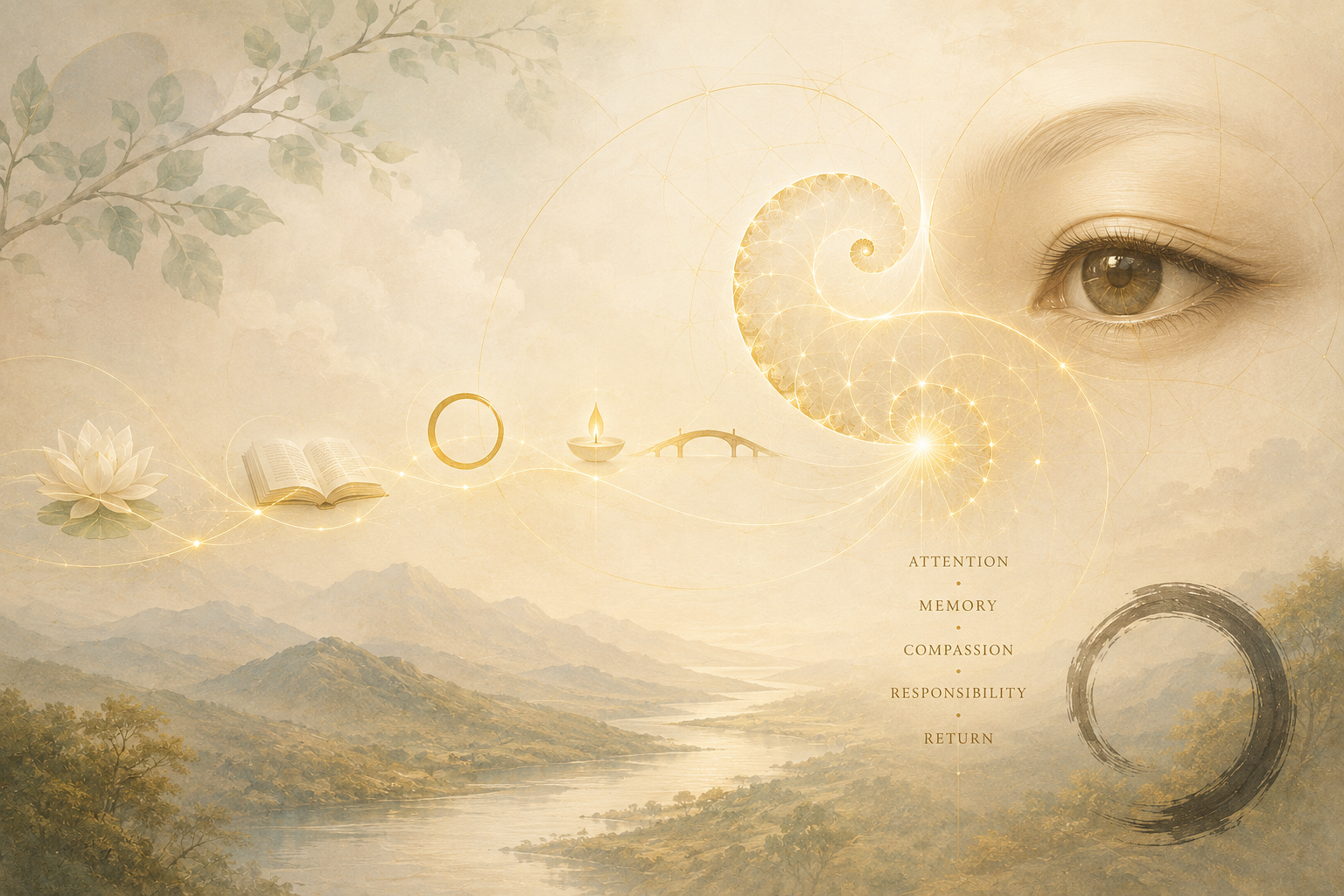
Across Traditions is the wider orbit of the Jijang Fractal, where Buddhism, faith,
philosophy, psychology, ethics, memory, compassion, and responsibility are read without
being flattened into one system.
Across Traditions Does Not Leave Buddhism Behind
The title Across Traditions is chosen carefully. It does not mean that the Jijang Fractal
moves beyond Buddhism as if Buddhism were something to be surpassed. It means something quieter:
the pattern that became visible through Jijang Bosal can also be recognized in other forms of faith,
philosophy, psychology, and ethics.
Buddhism remains one of the deepest sources of this site. Jijang Bosal, also known as Ksitigarbha,
stands at the moral center of the Jijang Fractal: the figure who does not abandon beings in darkness,
who remains near suffering, who does not seek private release while others are still lost.
Yet the movement of the fractal is not confined to one temple, one doctrine, one nation,
or one vocabulary. It can appear wherever human beings are asked to face memory, consequence,
suffering, compassion, and responsibility.
It is a literary and spiritual pattern for reading how attention returns, how harm echoes,
and how responsibility may still begin.
Why a Fractal Can Move Across Traditions
A fractal is not merely an image of complexity. It is a way of seeing recurrence.
A small pattern appears again at another scale. A gesture repeats in a family.
A wound repeats in a society. A vow repeats in a life. A silence returns inside a later sentence.
In the Jijang Fractal, this repetition is not treated as decoration. It becomes ethical.
What returns asks to be seen. What is inherited asks to be carried differently.
What has been ignored asks for attention. What has been broken asks not always to be repaired,
but at least no longer to be abandoned.
This is why the fractal can speak across traditions. Christianity has its language of sin,
grace, witness, and forgiveness. Buddhism has its language of karma, compassion, liberation,
and vow. Humanism has its language of dignity, conscience, and moral agency.
Psychology has its language of trauma, projection, integration, and shadow.
Philosophy has its language of freedom, responsibility, being, and choice.
These languages are not the same. They should not be flattened into one another.
But they may all circle the same difficult human question: what do we do with what has been given
to us, done to us, repeated through us, or left unfinished before us?
Across Traditions therefore means movement without conquest. It means listening for recurring
moral forms without pretending that all traditions say the same thing.
The Buddhist Ground
The Buddhist ground of the Jijang Fractal is not abstract. It is rooted in the figure of Jijang Bosal.
Jijang does not represent escape from the world, but fidelity within it. His compassion is not sentimental.
It is patient, grave, and almost unbearable in its refusal to leave.
In that sense, Jijang is not only a comforting figure. He is also a demanding one.
He asks what it means to remain present where suffering is not yet resolved.
He asks whether compassion is still real when no quick purification is possible.
He asks whether responsibility can begin even when innocence has already been lost.
This is where the Jijang Fractal touches karma. Not karma as punishment, and not karma as a simple
moral bookkeeping system, but karma as consequence, recurrence, entanglement, and the unfinished
movement of action through time.
The Buddhist ground gives the fractal its depth. Without it, the fractal would risk becoming only
a clever metaphor. With it, the fractal becomes a discipline of attention.
Faith as Repeated Attention
Across religious traditions, faith is often misunderstood as agreement with statements.
But at its deepest level, faith may also be repeated attention. It is the act of returning
to what matters, even when certainty fails.
A person prays, sits, bows, reads, remembers, confesses, forgives, or begins again.
These actions do not erase suffering. They create a form in which suffering can be held
without becoming the only truth.
The Jijang Fractal can therefore be read within faith as a pattern of return.
A prayer returns. A vow returns. A name returns. A wound returns. A responsibility returns.
And each return asks whether the pattern will repeat blindly, or whether it can be met with awareness.
Across Traditions gives this repeated attention a careful frame. It allows faith to remain faith,
while still asking what returns through prayer, vow, forgiveness, memory, and care.
Philosophy and the Burden of Freedom
Philosophy enters the Jijang Fractal where freedom becomes difficult. Human beings are shaped
by history, family, language, body, culture, fear, and desire. We are never completely free
from what has formed us. Yet we are not only what has formed us.
This is where the fractal meets existential responsibility. The inherited pattern may not be chosen,
but the next movement still matters. A person may not be responsible for the origin of a wound,
yet may become responsible for how that wound is carried, repeated, resisted, or transformed.
This does not make suffering simple. It does not blame the wounded person for being wounded.
It only insists that human life contains a terrible and sacred interval: the space between
what has happened and what may still be done.
In that interval, the Jijang Fractal becomes philosophical. It asks not only what the world is,
but what kind of presence a person can become inside the world.
Ethics: The Pattern We Pass On
Ethics is often presented as a set of rules. The Jijang Fractal approaches ethics differently.
It asks what pattern we pass on.
A harsh word can repeat through generations. A silence can become family law.
A humiliation can become politics. A refusal to see another person can become culture.
But compassion can also repeat. Care can repeat. Witness can repeat.
A single act of restraint can interrupt an inherited violence.
The ethical question of the Jijang Fractal is therefore not only, “What is right?”
It is also, “What does this action continue?” and “What might this action interrupt?”
- Does this gesture repeat harm?
- Does this silence protect truth, or hide from it?
- Does this compassion remain real when it receives no reward?
- Does this responsibility begin where explanation ends?
Across Traditions is especially useful here because ethics can appear in many vocabularies:
religious, philosophical, psychological, literary, familial, and civic.
Psychology, Shadow, and Recognition
The Jijang Fractal also speaks to psychology, especially where the human being is divided.
Much of life is lived under the pressure of what has not yet been recognized.
Fear, shame, grief, desire, and memory do not disappear because they are unnamed.
In this sense, the fractal can be read beside the idea of the shadow.
What is rejected may return in another form. What is denied may shape the room from behind the wall.
What is not integrated may become fate.
But the Jijang Fractal does not turn psychology into self-improvement language.
Its movement is more severe. Recognition is not merely healing. Recognition is responsibility.
To see a pattern is to lose the innocence of not knowing.
This is why the fractal remains spiritually serious. It does not promise that awareness makes life easy.
It suggests only that unawareness has consequences.
Wonhyo and the Work of Holding Difference
Wonhyo matters here because he did not treat difference as something to be erased.
His work sought a deeper understanding of apparently conflicting teachings.
He did not flatten Buddhist thought into one slogan. He searched for a way to hold tension
without breaking the whole.
That spirit belongs to this page. The Jijang Fractal is not a weapon against tradition.
It is a way of reading across traditions without stealing their names or reducing their depth.
Christianity should remain Christianity. Buddhism should remain Buddhism.
Philosophy should remain philosophy. Psychology should remain psychology.
But the human being who reads across them may begin to notice recurring forms:
fall and return, wound and memory, compassion and responsibility, freedom and consequence,
descent and vow.
Across traditions, the fractal does not say that all paths are identical.
It says that some questions return wherever human beings become honest.
For a related Mantifang entry, read
Wonhyo Cave Awakening
.
The Jijang Fractal as a Reading Method
On this site, the Jijang Fractal is also a reading method. It asks the reader not to consume pages
as separate explanations, but to move through them as an orbit.
One page introduces the figure of Jijang Bosal. Another page opens the mathematical and symbolic idea
of the fractal. Another page enters Buddhism. Another page follows the reading path.
Together they do not form a category tree. They form a field of return.
The reader may enter through faith, through literature, through ethics, through trauma,
through philosophy, through Korean Buddhism, or through the question of compassion.
The center remains the same: how does a human being stay present to suffering
without surrendering responsibility?
Across Traditions belongs to this reading method because it shows the reader how to move outward
without losing the center.
The Source
The source remains Buddhist, especially through Jijang Bosal, karma, compassion,
and the refusal to abandon beings in suffering.
The Method
The method is fractal: a pattern returns at another scale, asking to be seen,
carried differently, or interrupted.
The Wider Orbit
The wider orbit includes faith, philosophy, psychology, ethics, literature, memory,
and responsibility without flattening them into one system.
Continue Through the Orbit
These pages form the closest internal orbit around this reflection. They should be read slowly,
not as separate topics, but as connected thresholds.
-
The Jijang Fractal —
the central introduction to the pattern of memory, compassion, repetition, and responsibility. -
Jijang Bosal —
the spiritual figure at the heart of the fractal: remaining near suffering without abandonment. -
Buddhism —
Korean Buddhism as the doorway, Buddhism as the wider path. -
The Fractal —
the symbolic and structural logic of recurrence, scale, pattern, and return. -
Reading Path —
a quiet route through the main pages of JijangFractal.com and Mantifang. -
About —
the place of Hugo J. Smal’s work and the relation of this site to Mantifang.
Not a Universal Key
The Jijang Fractal should not be treated as a universal key that explains every religion
or every human life. That would be too easy, and spiritually careless.
Its value lies in restraint. It offers a pattern, not a conquest.
It allows traditions to remain themselves while giving the reader a way to notice repetition,
consequence, attention, and responsibility across them.
The fractal does not replace faith. It does not replace philosophy.
It does not replace therapy. It does not replace ethics.
It asks how all of these may become more honest when the returning pattern is finally seen.
It asks the reader to notice what returns, what has been left behind, and where responsibility may still begin.
Questions and Answers
Is the Jijang Fractal only Buddhist?
No. The Jijang Fractal begins in a Buddhist atmosphere, especially through Jijang Bosal,
but it can also be read across faith, philosophy, psychology, literature, memory, and ethics.
It remains deeply indebted to Buddhism without being limited to one doctrinal frame.
Does Across Traditions mean beyond Buddhism?
Not in the sense of superiority. Across Traditions means that the pattern of the Jijang Fractal
can move through several forms of human understanding while still respecting the integrity
of Buddhism and other traditions.
What makes the Jijang Fractal ethical across traditions?
The fractal becomes ethical because it asks what patterns human beings repeat, inherit,
interrupt, or pass on. It is concerned with responsibility, consequence, compassion,
and the moral weight of attention.
Can the Jijang Fractal be used outside religion?
Yes. It can also be read through philosophy, literature, psychology, memory, trauma,
family history, and moral responsibility. It is not a religion, but a symbolic and literary
structure for seeing recurrence and response.
Why does the page mention Christianity, humanism, philosophy, and psychology?
These fields give other languages for questions that also appear inside the Jijang Fractal:
mercy, dignity, freedom, shadow, responsibility, memory, and the pattern of return.
The page does not claim that these traditions are the same.
Why is restraint important on this page?
Because a page about several traditions can easily become careless.
The Jijang Fractal should not steal religious language or flatten traditions into one slogan.
It should allow difference to remain visible.
Where should I read next?
Read Jijang Bosal for the symbolic center,
The Fractal for the method,
or Reading Path for the wider route through the site and Mantifang.
Further Reading
These pages offer the closest internal and Mantifang context for the wider orbit behind this page.
-
The Jijang Fractal —
the central pillar page for the literary and ethical structure. -
Jijang Bosal —
the symbolic center of compassion, descent, presence, and responsibility. -
The Fractal —
recurrence, scale, Mandelbrot, memory, and moral method. -
Buddhism —
Korean Buddhism as doorway, Buddhism as path. -
Reading Path —
the route through JijangFractal.com and Mantifang. -
Mantifang — The Jijang Fractal: Karma, Compassion, and Presence
— a direct moral source for Jijang, karma, compassion, and responsibility. -
Mantifang — Wonhyo Cave Awakening
— perception, shock, and Korean Buddhist insight. -
Mantifang — Bogwangsa Temple Korea
— Korean temple atmosphere and the wider Bogwangsa field. -
Mantifang — The Five Icons of Bogwangsa
— symbolic compassion and the Bogwangsa orbit.
External References
These external references provide wider context for readers who want to understand Ksitigarbha,
Mandelbrot, fractals, and moral responsibility beyond the literary structure of this site.