
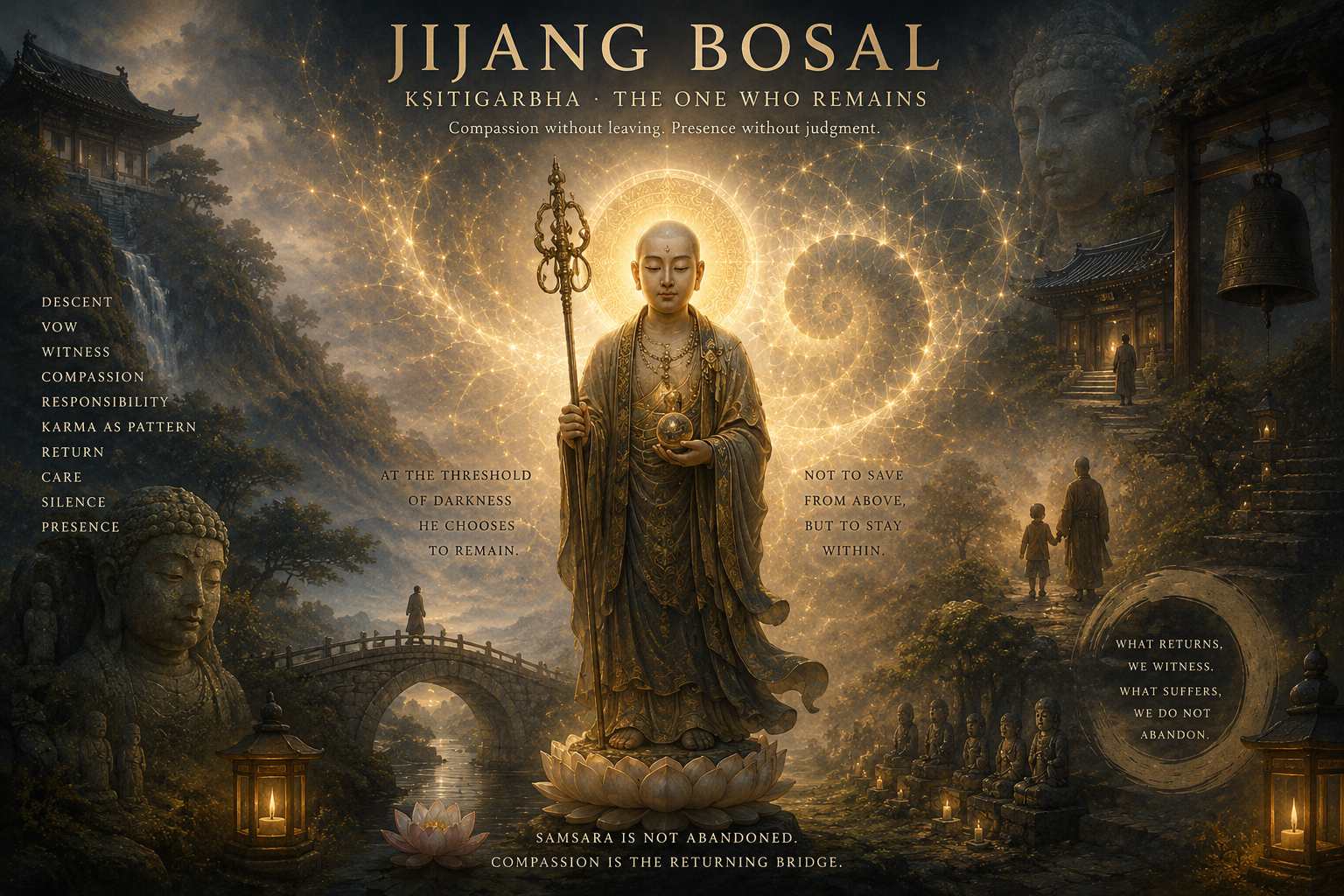
Symbolic center
Jijang Bosal
Jijang Bosal, known more widely as Ksitigarbha, is approached here as a Korean Buddhist figure
and as the literary image at the center of the Jijang Fractal: the one who descends, remains,
witnesses, and does not abandon suffering.
Jijang Bosal in the Jijang Fractal
Jijang Bosal is the Korean name connected to Ksitigarbha, a major bodhisattva in Mahayana Buddhism.
He is often associated with care for beings in difficult realms, with vows made near suffering,
and with compassionate presence at the threshold between darkness and release.
On JijangFractal.com, Jijang Bosal is treated respectfully, but not as a claim of religious authority.
This site does not present itself as a Buddhist teaching platform, a temple, or a doctrinal source.
It reads Jijang as a symbolic presence within Hugo J. Smal’s literary and ethical work:
one who descends, remains, witnesses, and accompanies what has not yet been healed.
That distinction matters. Jijang Bosal is not used here as decoration, mood, or exotic atmosphere.
He is not placed at the center of the Jijang Fractal because he is visually powerful or culturally distant.
He stands there because his figure gives language to the deepest movement of the work:
the refusal to abandon suffering simply because suffering cannot be solved.
In the Jijang Fractal, repeated images gather force. A bridge returns. A child returns.
A temple returns. A silence returns. A broken figure returns. These returns are not merely aesthetic.
They become moral. They ask what it means to remain present when the same wound, the same memory,
or the same responsibility appears again at another scale.
Jijang Bosal gives that recurrence a center. He is the figure who does not stand outside the difficult place.
He is not the distant observer of pain. He is the one whose compassion is measured by his willingness
to remain near what others would rather escape.
That symbolic function is especially clear in Mantifang’s
Letter to the Sangha / Karma, Compassion and Presence
,
where Jijang becomes a language for karma as pattern, compassion as presence,
and responsibility as relation.
not rescue from above, but presence within the difficult place.
The Name and the Threshold
The name Jijang Bosal carries the Korean form of a wider Buddhist figure.
In Sanskrit, the figure is known as Ksitigarbha. Across Mahayana traditions,
Ksitigarbha is associated with vows, difficult realms, beings in suffering,
and a compassionate refusal to leave anyone entirely abandoned.
For the Jijang Fractal, the name matters because it enters the work through Korean atmosphere.
It is not an abstract theological term floating above the text. It arrives through places,
temples, memories, images, and the lived sense of standing before a figure who represents
something older and quieter than explanation.
Jijang belongs near thresholds. He belongs where ordinary certainty fails:
between guilt and mercy, memory and release, death and care, judgment and compassion,
inherited suffering and the possibility of responsibility.
A threshold is not only a boundary. It is a place where one kind of seeing no longer works,
and another kind of seeing has not yet begun. The Jijang Fractal repeatedly returns to such places.
Bridges, temples, borders, rooms, dreams, and remembered encounters become threshold images.
They mark a passage, but also a hesitation.
Jijang Bosal stands inside that hesitation. He does not rush the passage.
He does not make a doctrine out of the wound. He does not offer a shortcut out of consequence.
He remains near the threshold until the human being can bear to see what has returned.
Descent without Spectacle
One of the strongest images connected with Jijang Bosal is descent.
This descent should not be misunderstood as drama. It is not an heroic adventure into darkness.
It is not a theatrical image of spiritual power. In the Jijang Fractal, descent means the willingness
to go toward what has been hidden, forgotten, damaged, or left behind.
The moral force of descent is restraint. Jijang does not descend in order to dominate the darkness.
He descends in order not to abandon those who remain there. That is why he becomes such a strong
figure for the project. He does not make suffering meaningful too quickly. He does not polish it
into beauty. He stays with it long enough for attention to become honest.
In literary terms, this is crucial. A book can use suffering badly. It can turn pain into spectacle,
trauma into decoration, or spiritual language into escape. The Jijang Fractal resists that movement.
It asks whether suffering can be approached without possession, without simplification, and without
the false comfort of immediate explanation.
Jijang Bosal is the counter-image to spectacle. He does not stand above the suffering person as a judge.
He does not use pain to prove a theory. He remains close enough to witness, but humble enough not to claim
that witnessing gives him ownership.
This is why the figure becomes literary as well as spiritual. Jijang teaches the book how to look.
He teaches it not to hurry. He teaches it to stay.
Compassion without Sentimentality
The compassion connected with Jijang Bosal is not sentimental. It is patient, grave, and difficult.
It does not erase suffering by naming it spiritual. It does not transform pain into a beautiful idea.
It does not turn care into softness alone.
In the Jijang Fractal, compassion is joined to responsibility. Compassion sees what suffers.
Responsibility asks what has returned, what has been carried, what has been passed on,
and what must no longer be abandoned.
This is where Jijang becomes severe. He is not severe because he condemns. He is severe because
he refuses to let compassion become vague. He does not allow care to remain only a feeling.
Care must take form. It must remain. It must witness. It must carry.
A sentimental compassion wants suffering to become moving, beautiful, or quickly healed.
Jijang compassion is different. It can stand in the unfinished place. It can remain even when
the wound does not close. It can see the person who has been left unseen.
That is also why Jijang belongs to the question of memory. Memory is not only the past.
Memory is what continues to act in the present. What has not been seen returns.
What has not been held returns. What has been pushed into silence returns in another form.
Jijang Bosal does not abolish that return. He gives the return a witness.
It is the disciplined attention that refuses to leave suffering unseen.
Jijang and the Logic of Return
The word fractal points to recurrence. A small pattern appears again at another scale.
A private memory echoes inside a public history. A personal wound reappears as culture.
A scene returns later as a moral question. A silence in one place becomes a judgment in another.
Jijang Bosal fits the fractal because he belongs to the place where recurrence becomes unbearable.
The same wound returns. The same silence returns. The same question returns:
who stays, who witnesses, who takes responsibility, and who is abandoned?
Without Jijang, the fractal could become only a pattern. It could remain intellectual,
elegant, even clever. Jijang prevents that. He makes the pattern ethical.
He asks what the repeated form does to actual beings.
This is one of the deepest reasons he belongs at the center. The Jijang Fractal is not only interested
in symbolic repetition. It is interested in moral recurrence. What returns is not neutral.
A repeated wound can become fate. A repeated silence can become family law. A repeated humiliation
can become culture. But care can also repeat. Witness can repeat. Responsibility can repeat.
Jijang is the figure who makes the reader ask which pattern is being continued.
He does not merely ask whether one understands the recurrence.
He asks what one does after seeing it.
Karma as Pattern, Not Punishment
The Jijang Fractal uses karma carefully. It does not treat karma as a simple moral bookkeeping system.
It does not use karma as blame. It does not say that suffering is deserved.
Karma appears here as pattern, consequence, relation, and return.
An action does not vanish after it has been done. A silence does not disappear because no one names it.
A wound does not always end with the wounded person. Something continues. Something echoes.
Jijang Bosal stands inside that field of echo. His compassion is not separate from karma.
It is compassion inside consequence. He is not the figure who cancels responsibility.
He is the figure who remains where responsibility has become too heavy for ordinary language.
In this sense, Jijang makes karma human. He prevents it from becoming cold abstraction.
If karma is only law, it can become frightening or mechanical. If karma is only metaphor,
it can become weak. In the Jijang Fractal, karma becomes the pattern of what continues,
and Jijang becomes the one who remains within that continuation.
This is why the Mantifang text
Karma, Compassion and Presence
is so important to the orbit. It places Jijang exactly where the literary, ethical,
and spiritual meanings of the project begin to touch.
Jijang Bosal and Korean Buddhist Atmosphere
JijangFractal.com begins in a Korean Buddhist atmosphere, but it does not reduce Korean Buddhism
to information or ornament. Korean temples, statues, ritual spaces, mountain paths, and remembered silences
form part of the emotional and symbolic ground of the work.
The figure of Jijang Bosal belongs to that ground. He stands near the question of how to remain human
when suffering cannot be solved by distance. His presence connects the work to Korean Buddhist imagery,
but also to wider questions of care, death, memory, karma, and moral consequence.
The Korean atmosphere matters because this project is not built from theory alone.
It emerges from encounters, travel, temples, conversations, misunderstandings, friendships,
thresholds, and the slow discovery that a place can become a moral image.
Bogwangsa, Goyang, Korean social memory, Buddhist images, and the wider archive of Mantifang all contribute
to the field in which Jijang Bosal becomes legible. The figure is not isolated. He stands inside a lived world.
For wider Korean spiritual context, the Mantifang
Korean Spiritual Dictionary
offers a broader index of figures, terms, and cultural references.
For a more specific Mantifang meditation on Bogwangsa and the symbolic field around compassion,
read
The Five Icons of Bogwangsa and the Fractal of Compassion
.
Not Authority, but Orientation
This page does not teach Buddhism as doctrine. It gives readers the symbolic minimum needed
to understand why Jijang Bosal stands at the center of the Jijang Fractal.
That distinction matters. The purpose here is not to claim expertise over Buddhist tradition.
The purpose is to show how one Buddhist figure becomes a literary and moral center:
a way of thinking about descent, care, witness, and responsibility.
A doctrinal page would ask what a tradition teaches in formal terms.
This page asks how a figure works inside a literary-spiritual structure.
It remains close to Buddhism, but it does not pretend to replace Buddhist study.
This restraint is essential to the site. JijangFractal.com is not a generic Buddhism site.
It is not an encyclopedia. It is not a temple substitute. It is a quiet gateway into a literary structure
shaped by Korean Buddhist imagery, ethical attention, and long-form spiritual reflection.
The reader is therefore invited to approach Jijang Bosal with respect, not possession.
The figure is not reduced to a tool for interpretation. He remains larger than the project.
The project only receives from him a form of attention.
not rescue from above, but presence within the difficult place.
How Jijang Shapes the Reading Path
To read the Jijang Fractal well, it helps to understand Jijang Bosal before moving too quickly
into the wider structure. Without Jijang, the fractal can seem like only a pattern.
With Jijang, the pattern becomes ethical.
The repeated forms in the work are not only aesthetic. They ask what human beings do with what returns:
guilt, memory, love, abandonment, silence, inherited pain, and the possibility of care.
Jijang Bosal holds the center because he gives those returning patterns a moral gravity.
He is the one who remains where others might prefer abstraction. He keeps the fractal close to suffering,
and therefore close to compassion.
The reading path should therefore not be rushed. Begin with the central structure.
Then return to Jijang. Then move outward toward the fractal logic, Buddhism, and the wider page
on traditions, philosophy, psychology, and ethics.
- Read Begin Here for the first threshold into the site.
- Read The Jijang Fractal for the central structure.
- Read this page, Jijang Bosal, for the symbolic center.
- Continue to The Fractal for recurrence, scale, pattern, and return.
- Move to Buddhism for the Buddhist ground.
- Move to Across Traditions when you are ready to follow the wider orbit.
Jijang for Non-Buddhist Readers
Non-Buddhist readers can enter this page without pretending to stand inside a tradition they do not belong to.
The required attitude is not ownership, but attention. Jijang Bosal can be approached here as a figure
who helps the reader understand the moral structure of the work.
A Christian reader may recognize echoes of mercy, descent, witness, or staying near the abandoned.
A philosophical reader may recognize questions of freedom, consequence, and responsibility.
A psychological reader may recognize the return of the unintegrated, the shadow, or the wound that repeats.
A literary reader may recognize the way images gather power by returning in changed form.
None of these readings replaces the Buddhist figure. They do not own him.
They circle him from different distances. Jijang remains rooted in Buddhist tradition,
while the Jijang Fractal receives from him a symbolic discipline of staying.
This is the careful balance of the page. It opens the figure to readers across traditions,
but it does not flatten him into a universal symbol without origin.
Questions and Answers
Who is Jijang Bosal?
Jijang Bosal is the Korean name connected to Ksitigarbha, a Mahayana bodhisattva associated with
compassionate presence in difficult realms and near spiritual thresholds.
Is Jijang Bosal the same as Ksitigarbha?
Jijang Bosal is the Korean form of the figure known in Sanskrit as Ksitigarbha.
The name changes across languages and traditions, but the figure is widely associated
with vows, care, descent, and beings who suffer.
Is Jijang treated as a god here?
No. The Jijang Fractal approaches Jijang Bosal as a Buddhist figure and as a literary symbol,
with respect and restraint. The emphasis is on symbolic orientation, not religious possession.
Why does Jijang fit the fractal?
Jijang fits the fractal because he offers an image of repeated care:
staying where suffering returns. The fractal shows recurrence; Jijang gives that recurrence
a moral and compassionate center.
Can non-Buddhist readers enter this page?
Yes. The page is written for literary, spiritual, and philosophical orientation.
It does not require the reader to be Buddhist. It asks only for respectful attention.
Does this page replace Buddhist study?
No. This page is not doctrinal instruction. Readers who want formal Buddhist study
should turn to qualified teachers, temples, and specialist sources.
Why is Jijang important to Hugo J. Smal’s work?
Jijang Bosal gives the work a central image of remaining near suffering.
This fits the wider themes of the Jijang Fractal: memory, karma, compassion,
responsibility, silence, and the refusal to abandon what has not yet been healed.
What is the first thing to notice about Jijang Bosal?
Notice that he remains. He does not turn away from suffering, and he does not turn it into spectacle.
His meaning begins in presence.
How does Jijang relate to karma?
On this site, karma is approached as pattern, consequence, relation, and return.
Jijang stands within that field as the figure of compassion that remains where consequence has become heavy.
Why is this page important to the reading path?
Because Jijang Bosal gives the Jijang Fractal its moral center.
Without him, the fractal could seem only structural. With him, recurrence becomes compassion and responsibility.
Further Reading
These pages form the closest orbit around Jijang Bosal within JijangFractal.com and Mantifang.
They can be read slowly, returned to, and used as a quiet route through the work.
-
The Jijang Fractal —
the central pillar page for the literary and ethical structure. -
The Fractal —
the symbolic logic of recurrence, scale, memory, and return. -
Buddhism —
the Buddhist ground from which the Jijang Fractal first takes shape. -
Across Traditions —
how the pattern moves through faith, philosophy, psychology, and ethics. -
Reading Path —
a calm route through the site and the wider orbit. -
Mantifang — Karma, Compassion and Presence
— the direct moral source for Jijang, karma, and compassionate presence. -
Mantifang — The Five Icons of Bogwangsa and the Fractal of Compassion
— a deeper symbolic entry into Bogwangsa and the field of compassion. -
Mantifang — Korean Spiritual Dictionary
— a broader index for Korean spiritual vocabulary and figures.
External References
These external references offer wider context for readers who want to understand Ksitigarbha,
bodhisattvas, and Mahayana Buddhism beyond the literary use of Jijang Bosal on this site.
Continue in the Mantifang archive
JijangFractal.com is the focused gateway. Mantifang remains the deeper archive, with the full orbit of chapters, Korean Buddhist background, Wonhyo texts, Bogwangsa material, and related spiritual context.
Jijang Fractal Orbit Korean Spiritual Index Bogwangsa Temple Letter to the Sangha